A New Sound Changed the Space Around It
Rock and roll’s cultural impact was never confined to the notes on a record. It changed what young people danced to, which performers commanded public attention, how adults discussed popular entertainment, and what an aspiring musician imagined was possible. A song could travel from a local studio to a bedroom radio, a dance floor, or a television screen, carrying styles and attitudes across boundaries that remained firmly enforced elsewhere. That movement helped reshape culture, but it did not make the music a simple force for universal progress. Rock’s history includes racial borrowing and unequal reward, rebellion sold as a product, and communities that challenged some hierarchies while preserving others. Understanding its influence requires holding those realities together. The story is less about one genre single-handedly changing the world than about music becoming a powerful meeting place for existing social pressures, new technologies, and people determined to be heard.
A: Its emergence involved several musical traditions and communities; a single-inventor account obscures that exchange.
A: No. Musical circulation could cross boundaries while institutions continued enforcing unequal access and reward.
A: They became a visible audience with shared tastes, social spaces and commercial influence.
A: Yes. Participation, bodily expression and who is permitted to share a space can all have social significance.
A: No. Rock participated in a much broader history that included spirituals, gospel, folk and other traditions.
A: Its meaning could challenge norms even while businesses organized its production and distribution.
A: It offered a format for sustained artistic sequences and invited attention beyond individual hit singles.
A: Their symbolic unity could coexist with unequal experiences and practical conflicts over access and control.
A: A fuller history explains both musical influence and the unequal visibility shaping the familiar canon.
A: Local musicians adapted its sounds and meanings to their own languages, traditions and social circumstances.
The Revolution Had Roots
The roots are audible before the usual 1950s starting line. Sister Rosetta Tharpe’s 1944 ‘Strange Things Happening Every Day’ joins gospel address to buoyant piano and electric-guitar attack. Chuck Berry’s 1955 ‘Maybellene’ brings a country-associated narrative of pursuit into a driving rhythm-and-blues setting. Neither record is an anonymous ingredient waiting for a later star to make it meaningful. These are accomplished performances by Black artists with their own audiences and ambitions. Hearing them first changes what the arrival of white crossover stars appears to represent.
Sister Rosetta Tharpe is a particularly useful figure for understanding the connection between gospel performance and forceful electric guitar. The Rock & Roll Hall of Fame’s account of her influence places her within rock’s musical ancestry. Remembering such artists changes the familiar picture of a genre supposedly created only by young men in the 1950s. Its public breakthrough depended on sounds and performance languages that had already been cultivated.
Origins also complicate the search for a single first rock and roll record. Different candidates emphasize rhythm, instrumentation, attitude, sales, or the label used at the time. The more productive question is how these elements converged and reached new audiences. That approach explains cultural change without forcing a diverse musical history into one heroic starting moment.
Race Shaped Both Access and Reward
Elvis Presley’s first Sun single in 1954 paired Arthur Crudup’s blues song ‘That’s All Right’ with Bill Monroe’s ‘Blue Moon of Kentucky.’ The pairing makes musical exchange concrete: the same small group redirected material associated with different racialized commercial markets. Presley’s clipped, mobile delivery and the buoyant accompaniment created a distinctive interpretation. His enormous subsequent exposure also raised a harder issue: visibility for a white interpreter did not guarantee comparable access or reward for the Black artists whose recordings helped shape his vocabulary.
This does not reduce every performance to theft or every collaboration to equality. Specific histories differ, and musicians often developed serious admiration, working relationships, and creative exchanges. The important distinction is between individual influence and the larger system that decided who could become the most visible representative of a sound. Listening with that distinction in mind allows appreciation without accepting simplified myths of origin.
Teenagers Became a Recognizable Audience
The opening use of Bill Haley and the Comets’ ‘Rock Around the Clock’ in the 1955 film Blackboard Jungle helped connect rock and roll with a screen story about adolescent conflict. The association was powerful because it gave an unfamiliar sound an immediately recognizable social setting. Adults could hear the record as evidence of disorder, while young audiences could claim the same energy as their own. Rock did not invent teenage independence, but a record attached to a film could make that independence public and marketable. The TeachRock historical timeline connects these early recording and media breakthroughs. The cultural change involved a new listening constituency becoming difficult for advertisers, broadcasters and parents to ignore.
Dance Made Listening Physical and Social
A dance floor turns music into a visible relationship among people. Rock and roll’s rhythmic energy encouraged participation that could be watched, judged, imitated, and debated. The body became part of how listeners understood the sound, whether through a carefully learned dance or spontaneous movement. That experience differed from treating popular music only as something to hear politely while seated.
Dance spaces and televised performances could also expose tensions around race and social respectability. Some encounters crossed established boundaries, while other institutions carefully controlled who appeared and who participated. It would be inaccurate to describe every dance floor as liberated simply because the soundtrack was new. Still, the sight of young people moving together gave the music a public presence that recordings alone could not supply.
This physical dimension helps explain why rock’s impact cannot be read only from lyrics. A song with ordinary words might challenge expectations through its groove, the performer’s movements, or the audience’s response. Cultural meaning arose in the event of participation. The same recording could carry different implications in different rooms, depending on who was allowed to enter and what their movement represented.
Media Turned Local Performers Into Shared Images
On February 9, 1964, the Beatles performed on The Ed Sullivan Show in their first appearance on that American television program. The show’s archive preserves the event’s context. The coordinated suits, distinctive hair and close-up introductions made four individual personalities available within a recognizable group. Songs such as ‘All My Loving’ turned the band into a shared household image, while the screaming audience showed that young women were active makers of the event’s meaning.
Visibility also changed the relationship between performer and fan. Listeners could encounter a hairstyle, a gesture, or an instrument as part of a repeatable image, then bring it into their own lives. That image was rarely independent of commercial choices about promotion and access. Media made identification more immediate while giving broadcasters and companies substantial power over which musicians became familiar.
The Band Became a Model of Creative Possibility
A rock band offered an appealing picture of people making something together outside more formal institutions. Friends could imagine rehearsing in an ordinary room, learning parts by ear, and building an identity through a shared sound. The actual work required resources, persistence, and skill, but the visible model felt reachable to many aspiring players. It suggested that musical participation did not always begin with admission to an elite organization. This encouraged local scenes and a continuing cycle of imitation followed by invention. The cultural effect was not that everyone could become famous; it was that more people could picture themselves taking part in music-making, even at a modest neighborhood scale.
From Entertainment to an Artistic Claim
The Beatles’ 1967 Sgt. Pepper’s Lonely Hearts Club Band made the album an especially visible claim for studio-made popular art. Producer George Martin and the engineers helped turn four-track recording into a construction process involving overdubs, edits and unusual instrumental combinations. ‘A Day in the Life’ joins contrasting Lennon and McCartney passages through orchestral escalation rather than presenting one uninterrupted stage performance. The band’s session history documents the extended work behind it. A listener buying the album encountered a designed sequence and an imagined performance world, not merely a stack of independent singles.
That shift created opportunities but also new hierarchies. Claims of artistic importance sometimes dismissed dance music, teenage enthusiasm, or supposedly less serious performers. A genre that challenged cultural gatekeeping could develop gatekeepers of its own. The useful legacy is an expanded sense of possibility, not the idea that one kind of listening or one audience was inherently superior.
Studio work was part of this change. Musicians and producers could construct sounds that did more than document a band in a room, making the record a creative object in itself. Such experimentation affected later styles well beyond rock. It also changed what listeners expected from a release: not only a performance, but an imaginative world assembled through sound.
Protest Used Music Without Belonging to One Genre
Rock became associated with opposition, but protest music had deep traditions outside it. Spirituals, gospel, folk, and other forms supplied songs that people used collectively in social movements. The Library of Congress’s account of civil-rights freedom songs makes that broader inheritance clear. Rock artists participated in this wider musical landscape rather than inventing the connection between song and political action.
A recording could criticize a policy, convey alienation, or become associated with a cause through its audience. Those are different forms of influence. Singing along may affirm belonging, but it is not identical to organizing, changing law, or redistributing power. Music can energize action and preserve memory while still depending on people and institutions to produce lasting political results.
Concerts Made Community Visible
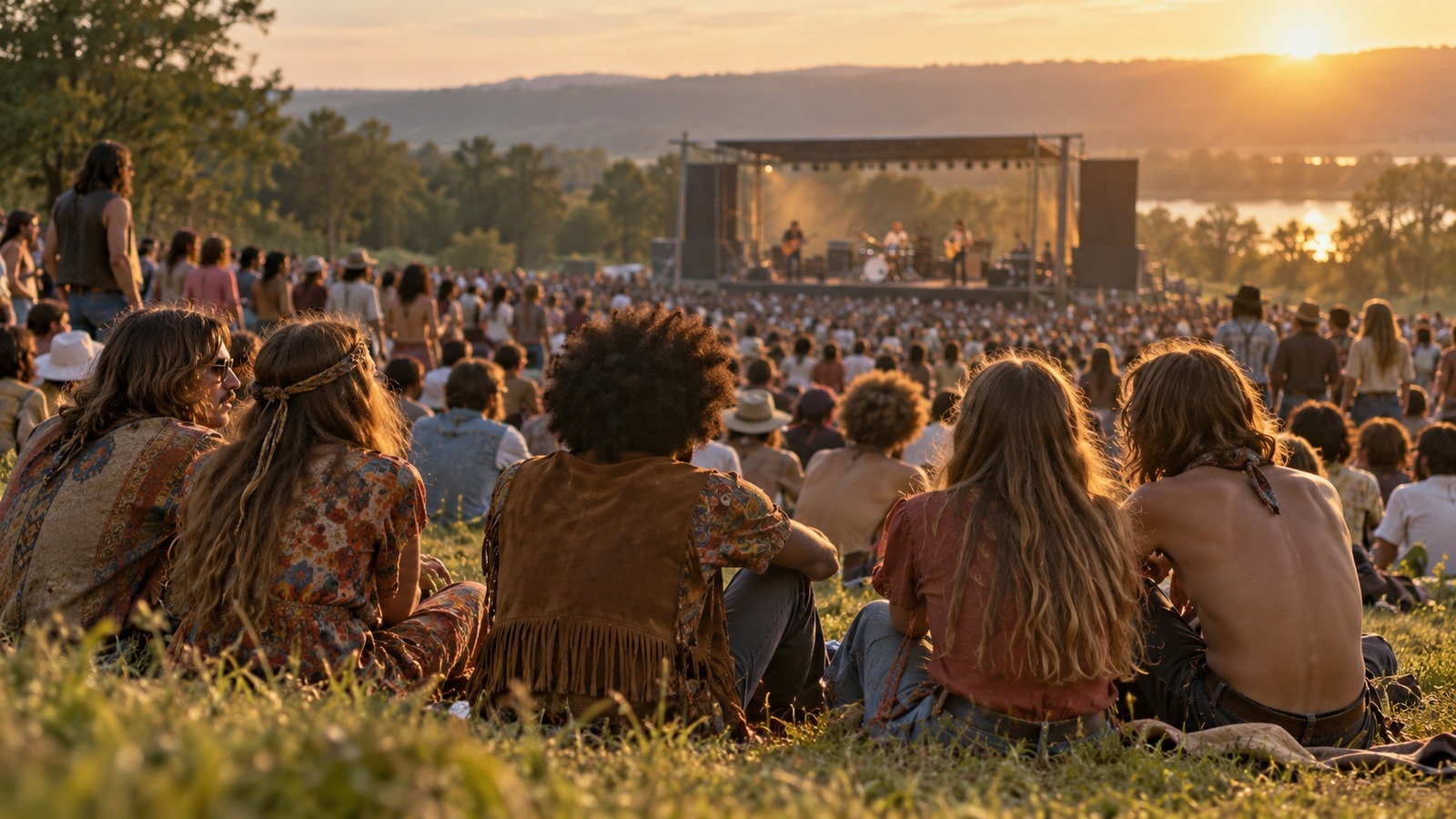
Woodstock gathered rock, folk, soul and blues performers on farmland in Bethel, New York, from August 15 into August 18, 1969. Richie Havens opened; Jimi Hendrix performed on the final Monday morning. The National Park Service account documents both the gathering and its later symbolic importance. Hendrix’s ‘Star-Spangled Banner’ made a familiar national melody collide with bent pitch, sustained noise and abrupt changes of texture. That sound could carry wartime associations without requiring a sung political speech. The festival made a huge temporary public visible, but food, transport, weather and unequal participation remained practical facts beneath the image of unity.
Rebellion and Commerce Grew Together
Rock often sold an image of independence through highly organized businesses. Labels, promoters, broadcasters, retailers, and advertisers helped distribute music that appeared to reject conformity. This was not merely a contradiction imposed from outside. Performers could need commercial resources to reach listeners while trying to retain control over their work. The resulting negotiation shaped careers as much as any public declaration of rebellion.
Fans also participated in that tension. Buying a record or adopting a style could express a personal refusal, yet the object might be produced and marketed by a large company. Commercial success did not automatically eliminate meaningful expression, and commercial opposition did not guarantee artistic integrity. Each case requires attention to what musicians made, how it circulated, and who benefited.
The same pattern appears when a once-provocative sound becomes ordinary advertising material. Culture can absorb challenges, turning unfamiliar gestures into familiar commodities. That does not erase the earlier impact, but it changes the context in which later audiences encounter it. Rock’s history shows how quickly an oppositional style can become part of the mainstream it once unsettled.
Who Was Allowed to Represent the Genre?
The public image of rock has often centered male performers, especially guitarists, even though women contributed as singers, instrumentalists, writers, producers, and scene builders. Questions of visibility affect whose work enters the canon and whose influence becomes difficult to trace. A narrow image also changes what aspiring musicians believe is available to them. Cultural history therefore includes the struggle to be recognized as a participant.
The same scrutiny applies to race, sexuality, geography, and class. A genre can offer liberation to some people while reproducing exclusion for others. Expanding its history does not require denying familiar achievements; it requires placing them among a fuller range of contributors. The resulting account is more accurate and better able to explain why different listeners experienced the music differently.
Local Scenes Changed a Global Language
Shonen Knife supplies one specific route beyond a Britain-and-America story. Formed in Osaka in December 1981, the group developed concise, melodic guitar music within a Japanese independent setting. Its 1983 Burning Farm release later circulated through the American label K, and its official chronology records a UK tour with Nirvana in 1991. Those exchanges were not simply rock arriving in a passive new market. Japanese musicians were making records that redirected the listening of overseas peers. The label’s chronology makes the movement of records, labels and touring relationships visible. Rock’s global life grew through these specific reciprocal networks, not through one uniform culture replacing every local one.
The Impact Lives in Habits as Well as Monuments
Rock’s influence survives in ordinary practices: starting a band, treating an album as an artistic statement, using clothing to signal musical belonging, or gathering around a performance to imagine a shared identity. Its history also survives in debates over credit, ownership, authenticity, and access. These effects extend beyond a single sound or generation. They are habits that later musical cultures can inherit, revise, or reject.
To understand how rock changed the world, follow those concrete relationships rather than attributing every social change to a famous song. Hear the musical roots, examine the institutions, and notice who gained a voice and who still struggled to be heard. The result is a history with more human agency and fewer easy legends. Rock and roll mattered because people used it to make themselves audible, and because the surrounding culture had to respond.