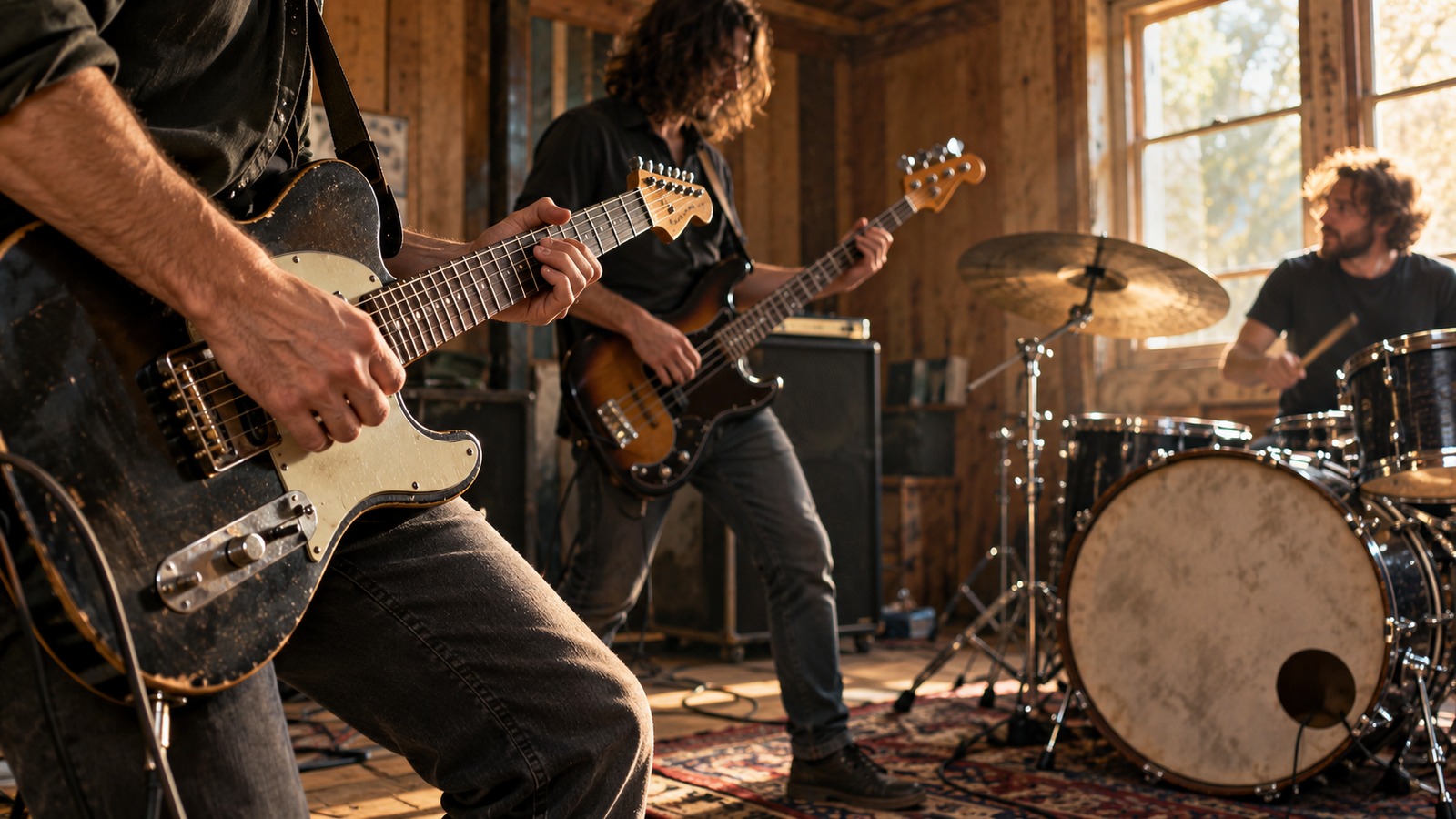
When a Band Becomes One Sound
You can often feel a great rock song working before you can explain it. A guitar figure catches your attention, the drums give it a direction, and a voice arrives with something urgent to say. What begins as several separate sounds becomes a single gesture: a swagger, a rush, a refusal, or a moment of release. That effect does not depend on expensive equipment, complicated harmony, or musicians playing as fast as possible. It comes from decisions that support one another. The bass makes the guitar sound heavier; a pause gives the next chord more force; a restrained verse makes the chorus feel larger. Different listeners will choose different favorites, but learning to hear these relationships makes almost any rock recording more interesting. The essential elements are useful listening tools, not a checklist that every song must satisfy. Some records succeed through glorious excess, others through startling economy, and the strongest ones make their chosen approach feel necessary.
A: Yes. Rhythmic conviction, vocal character and purposeful contrast can create intensity without constant loudness.
A: A riff is a recurring musical figure; a hook is any memorable attention-catching element. One idea can be both.
A: No. Some arrangements benefit from a solo, while others express their ideas more strongly without one.
A: Register, texture, harmony, articulation and instrument entrances can expand its character while the beat stays steady.
A: No. Excess distortion can blur rhythmic attacks or mask other parts; its effectiveness depends on the whole arrangement.
A: A stable foundation gives the guitar's movement a clear reference and prevents every instrument from competing for attention.
A: Sometimes its phrasing and emotional direction serve the song better than a technically cleaner performance.
A: Placement, articulation, supporting parts and meaningful periods of absence can renew a familiar pattern.
A: They can serve different circumstances. Comparing them helps distinguish the composition's core from performance-specific choices.
A: Choose one relationship, such as bass and drums, then follow how it changes between sections.
Energy Has More Than One Shape
Rock is often associated with volume and distorted guitars, yet intensity is not the same as loudness. A quiet performance can feel charged when its rhythm, phrasing, and emotional direction are persuasive. Conversely, an enormous wall of amplification may feel static if every part competes for the same space. The useful test is whether the song makes you anticipate what comes next, even when you already know the recording well.
The genre also has more than one musical ancestry. Blues, rhythm and blues, gospel, country, and other traditions helped shape rock and roll; the Rock & Roll Hall of Fame’s Roots of Rock exhibition provides historical context for those connections. That background helps explain why a shuffle, a vocal response, a dance rhythm, or a clean guitar can sound entirely at home in rock. There is no single guitar tone that grants a song membership. Its identity emerges from how musicians transform inherited sounds into a performance with a recognizable attitude.
The Riff Gives Repetition a Personality
A riff is a short recurring musical figure, usually associated with an instrument rather than the main sung melody. Its job is not merely to fill the gaps between vocal lines. A successful riff establishes a physical shape you recognize: a climbing motion, a stubborn repeated note, a rhythmic interruption, or a sudden drop. It can announce the song in a few seconds and continue organizing your attention after the singer enters.
Pitch and rhythm work together here. Play the same notes with different accents, and a riff can lose its bite or acquire a new swagger. The rests are especially revealing because they leave room for a drum hit, a bass response, or the listener’s expectation. A memorable figure does not need many notes; it needs a clear relationship between movement and silence. Repetition then becomes a source of pleasure rather than evidence that the writer ran out of ideas.
Listen for what happens when the riff returns. It may arrive beneath a new vocal line, with an extra guitar layer, or after a passage that temporarily removes it. Those changes let a familiar shape carry fresh meaning. A riff that dominates every moment can become exhausting, while one held back for the right entrance can feel much larger than its actual length. Good arrangement turns recognition into a dramatic event.
Drums and Bass Make the Song Move
The rhythm section supplies more than a metronome. The drummer chooses which beats feel settled and which feel exposed, while the bassist decides how firmly to anchor the harmony and when to travel between chords. When those decisions fit together, even a simple pattern develops a specific gait. Notice whether the bass aligns with the kick drum, stretches across its hits, or answers the guitar instead. Each relationship changes where the music seems to place its weight. Small variations can make a chorus push forward without requiring the entire band to speed up. The strength of a groove lies in shared intention, including how the players handle the spaces between the obvious beats.
A Hook Can Live Outside the Chorus
The word hook describes an element that catches and retains attention, and a chorus is only one possible location. A vocal phrase, a guitar entrance, a rhythmic accent, or an unusual sound can serve that purpose. Sometimes several hooks cooperate: the opening figure brings you in, the verse gives you a memorable vocal rhythm, and the refrain supplies the line you want to sing. They work best when the ear can distinguish their roles.
Melodic shape matters as much as range. A tune that stays close to one pitch can become gripping through repeated rhythmic insistence, while a large upward leap may create a feeling of release. Consider where the melody settles in relation to the chords. A stable landing can provide reassurance; a less settled note can keep a familiar refrain slightly unsettled. The lasting hook usually feels easy to remember while remaining expressive inside the song’s particular emotional world.
The Voice Supplies a Point of View
A great rock vocal does not have to be conventionally beautiful. Its value may lie in grain, restraint, vulnerability, rhythmic confidence, or the sense that the singer cannot quite contain the words. Technique still matters, but it serves communication rather than an abstract contest of range. A perfectly centered pitch can sound lifeless if the phrasing has no intention; a rough edge can be compelling when it belongs to the moment.
Pay attention to the beginning and ending of phrases. A singer who enters slightly ahead of a beat can sound impatient, while a delayed entrance may feel relaxed or defiant. Consonants can act like percussion, and held vowels can suspend the rhythm without stopping the band. These are interpretive choices, whether carefully rehearsed or discovered during a take. They determine how a line behaves, not just which words the audience hears.
The vocal also needs a relationship with the instruments. A dense guitar part may step aside when the lyric requires clarity, then return as a response. A harmony voice can turn a solitary statement into something communal, whereas a doubled lead can thicken the sound without suggesting another character. The most effective choice depends on the song’s perspective. More voices are not automatically more emotional, and a solitary voice is not automatically more sincere.
Lyrics Earn Their Place Through Specificity
Rock lyrics can tell a story, sketch a situation, repeat a charged image, or make ordinary speech feel newly forceful. They do not need a complicated plot to work, but they benefit from language that sounds connected to a particular speaker. A concrete action or recognizable detail can carry more feeling than a sequence of broad emotional declarations. Words also have to survive being sung: their accents, consonants, and lengths interact with the melody. A line that reads elegantly may resist the groove, while a plain phrase can become unforgettable through timing. Judge the lyric as part of a performance, including what the singer emphasizes and what the band allows you to hear.
Contrast Creates the Payoff
A chorus feels powerful partly because of what precedes it. The band can narrow the verse, shorten the guitar notes, reduce the cymbal activity, or keep the vocal in a lower register. When those restrictions loosen, the release feels earned. The change need not be a dramatic jump in loudness. A wider harmony, a longer-held chord, or a different rhythmic pattern may open the space just as effectively.
Contrast also operates inside sections. A brief stop can underline a phrase, and a fill can announce a transition before the harmony changes. The danger is treating every moment as a climax, leaving the listener with no sense of scale. Strong songs distribute their excitement across time. They let anticipation, impact, and recovery take turns rather than relying on uninterrupted force to hold attention.
Arrangement Is the Art of Choosing Roles
Arrangement determines what each instrument contributes and when that contribution becomes audible. Two guitarists can create a rich sound by using different registers, contrasting rhythms, or complementary tones. If they play equally busy parts in the same range, the result may obscure both ideas. Bass and keyboards face similar choices. A part can be excellent in isolation yet weaken the song because another instrument already performs its function.
One useful listening exercise is to imagine removing a layer. Does the recording lose its identity, or does a central idea become clearer? This is not an argument that sparse arrangements are always superior. Elaborate records can be magnificent when their layers support a hierarchy: something leads, something anchors, and something adds color. The listener does not need to notice every detail consciously for that organization to make the music feel coherent.
Transitions expose the quality of those decisions. A new section might begin with the whole band, or it might reveal its instruments one at a time. An ending can resolve the argument, cut it short, or make repetition feel like a continuing experience beyond the recording. There is no universally correct method. The arrangement succeeds when its entrances and exits reinforce the song’s scale, character, and emotional direction.
Guitar Tone Works in Context
Distortion can add sustain, harmonic complexity, and the sensation of friction, but it can also blur the attack of a chord. A cleaner sound may leave the rhythm more exposed and allow the bass to define the weight below it. Neither approach is inherently more authentic. Tone should be judged against the other instruments, the vocal, and the pace of the arrangement. A sound that seems thin alone may occupy exactly the right space in a full band. Conversely, a huge isolated guitar can swallow the frequencies that make the singer intelligible. Effective rock tone is a relationship among sounds, not a trophy awarded to the largest amplifier.
A Solo Should Change the Conversation
A solo offers a temporary shift of attention, and its musical purpose can be broader than displaying technical skill. It may extend the vocal melody, sharpen the rhythmic tension, introduce a new register, or provide a release before the final refrain. A few carefully shaped phrases can accomplish more than continuous fast playing. The listener should feel why this passage belongs at this particular point in the song.
Notice how the band supports it. The rhythm section may stay steady to give the lead instrument freedom, or it may respond with accents that create a more active exchange. A solo also needs an exit: a phrase that hands attention back to the voice or prepares the next section. Without that sense of destination, even impressive playing can feel detached. Musical technique becomes expressive when its details participate in the larger movement.
The Recording Makes Choices Too
The record you hear is a presentation of the performance, not simply a transparent window onto a room. Microphone placement, balance, ambience, editing, and the choice of take all influence how close or distant the band feels. A vocal placed prominently can make the words seem intimate; a roomier drum sound can suggest communal space. These effects are part of the listening experience even when you do not know how they were achieved.
Polish and roughness are both capable of serving a song. An audible imperfection may communicate effort or urgency, but keeping every mistake does not automatically preserve character. Likewise, precision can highlight an arrangement’s strength without eliminating feeling. The better question is what the production asks you to notice. Does it reveal the groove and perspective, or does its surface distract from them?
Compare versions only after giving each one a fair hearing. A live performance might redistribute the energy because the musicians respond to a room, while the studio version may use contrasts difficult to reproduce onstage. Neither has to invalidate the other. Their differences can reveal which elements carry the composition and which belong to a particular performance. That distinction makes repeat listening more rewarding than simply choosing the louder or cleaner version.
Listen for the Relationship That Holds Everything Together
There is no formula that guarantees a great rock song, and taste cannot be reduced to a scorecard. The useful habit is to identify the central relationship: perhaps the singer and riff, the bass and drums, or the quiet passage and its explosive return. Follow that relationship through the entire recording and notice how the other parts support it. A familiar song may reveal a bass movement or a held-back entrance you previously overlooked. Greatness often lies in those coordinated choices, where craft produces a feeling larger than any individual contribution. Once you hear the band as an interacting whole, technical details stop being distractions and become ways to understand why the music stays with you.