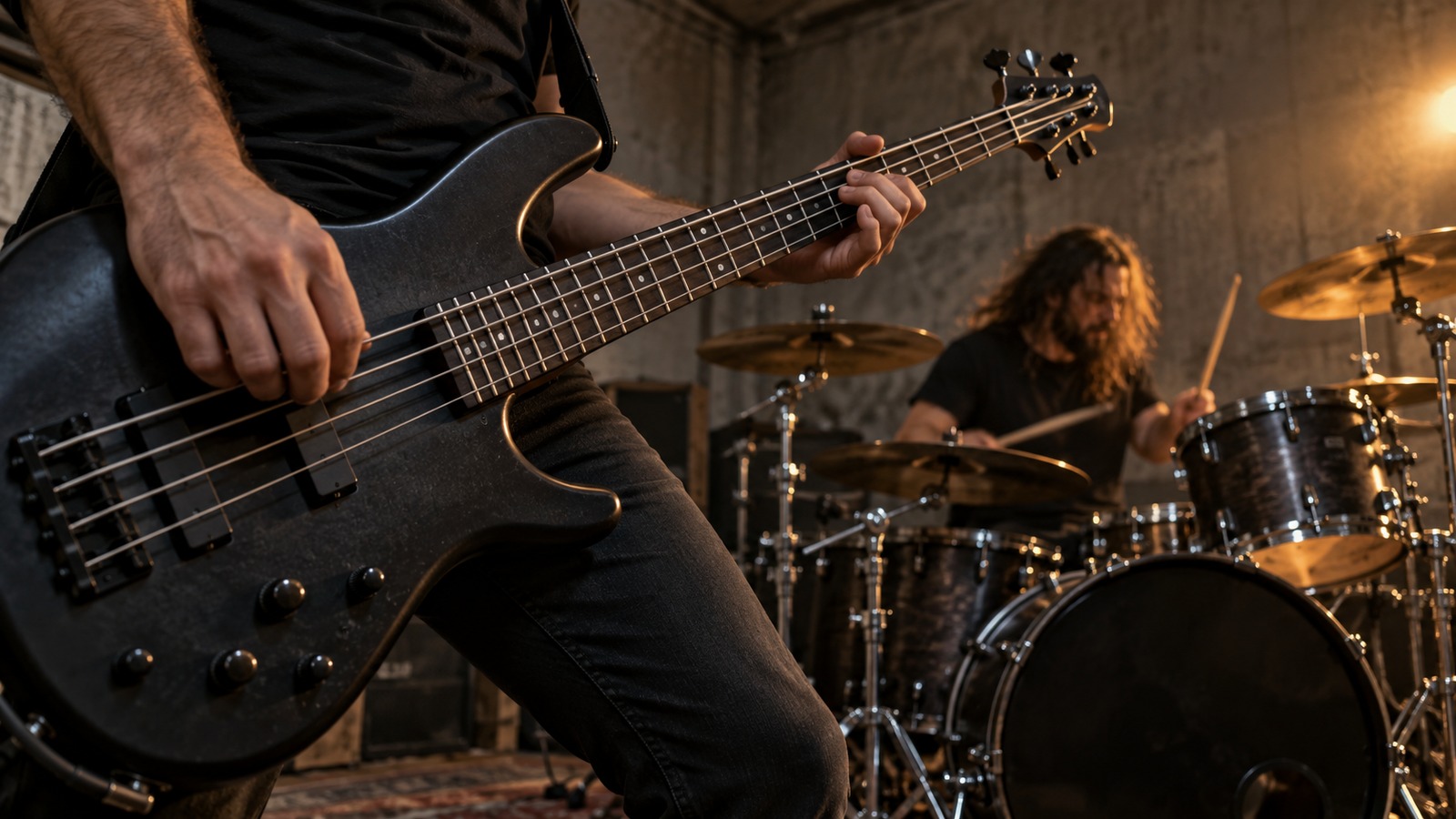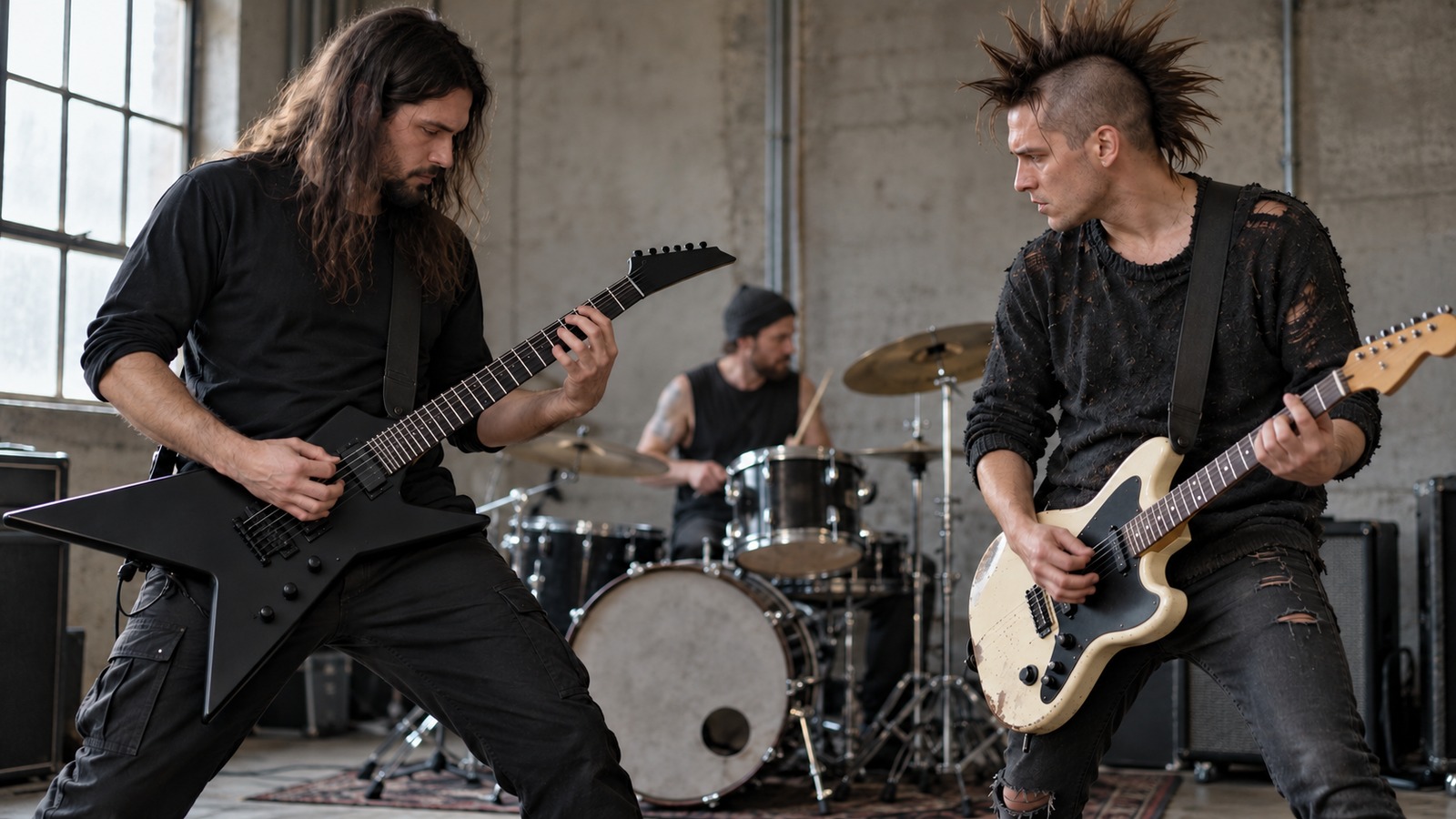
Loud Guitars Are the Beginning of the Comparison
Distorted guitars, insistent drums, and a forceful voice can make metal and punk appear closely related on a first encounter. The shared resources are real, but volume does not explain the different ways musicians organize a song or imagine their place within a scene. Metal often makes the riff, tonal weight, and instrumental development central, while punk frequently concentrates its force through direct attack, economical forms, and a culture of participation. Neither tendency is a rule that every band must follow. This comparison examines the sound and the cultural priorities together, leaving room for melodic punk, concise metal, experimental work, and the many crossings between them. Hear what the band builds with its amplified resources before judging the genre by a hairstyle, a tempo, or an assumption about technical skill.
A: No. Shared amplification makes arrangement and context more informative.
A: It can organize the whole ensemble and guide a song's structure.
A: Directness still depends on effective timing, articulation and delivery.
A: Simple riffs can be central to their musical force.
A: Artists and communities have varied subjects and perspectives.
A: Its range includes clean singing and several other approaches.
A: Independent production and organization occur in metal and other fields too.
A: Production can clarify a direct performance without removing its force.
A: They show artists combining resources associated with both traditions.
A: Hear rhythm, recurring material, vocals and the complete section sequence.
Shared Rock Resources Do Not Produce One Musical Aim
Metal and punk both developed within the larger history of rock music. Electric guitar, bass, drums, and vocals can provide a common ensemble, while distortion and emphatic articulation give performances physical impact. That shared setup makes comparison useful. It also explains why one isolated sound may be insufficient to distinguish the traditions.
The differences emerge through the relationships among those sounds. A band may build a passage around a low recurring riff, drive rapidly through a sequence of chords, or combine both approaches within one song. Hear the arrangement and the phrase lengths rather than using loudness as the deciding feature. The same basic resources can support different forms of tension and release.
Metal Commonly Gives the Riff Structural Weight
Black Sabbath’s ‘Iron Man,’ from 1970’s Paranoid, makes the riff a structural subject. Tony Iommi’s bent opening pitch and the heavy, separated figure give the band a recognizable shape before Ozzy Osbourne’s narrative arrives. Later sections change speed and instrumental activity, so the song develops beyond a single driving chord pattern. The band’s anniversary account identifies the original album context. This is a practical metal starting point: hear how the returning figure reorganizes the whole ensemble’s weight.
A new riff can function as a major structural event. Changes in register, rhythm, or harmonic direction can give successive sections distinct characters even when a vocal melody is not carrying the development. Follow the instrumental material through an entire song. This reveals how the composition builds its scale and atmosphere.
Not every metal riff is complicated, and simplicity can be central to its force. A short figure may acquire weight through repetition, tone, and the spaces around its attacks. Technical detail is meaningful when it supports the phrase rather than merely demonstrating activity. Listen for what the recurring material makes possible across the arrangement.
Punk Often Concentrates Its Impact
The Ramones’ 1976 ‘Blitzkrieg Bop’ supplies the contrasting punk example. Johnny Ramone’s continuous chord attack and Tommy Ramone’s straight, propulsive drumming create a fast-moving common surface; Joey Ramone’s short vocal phrases and group-call refrain make the recording easy to join. The arrangement presses forward through compact sections instead of suspending the song for an extended instrumental journey. Compare the guitar’s job with ‘Iron Man’: Sabbath repeatedly foregrounds a shaped figure and its changing contexts, while the Ramones make uninterrupted drive carry changing chords and a collective vocal gesture. Neither approach is a simple test of how many notes the players know.
The Histories Developed Through Different Pressures
Heavy metal is associated with the intensified guitar-based rock of the late 1960s and early 1970s, while punk became especially visible through its 1970s scenes. The Rock Hall’s cities and sounds exhibition connects early heavy metal with bands including Black Sabbath, Led Zeppelin, and Deep Purple. This background situates metal within a developing rock vocabulary rather than treating it as a sound invented without predecessors.
Punk’s emergence also involved responses to existing musical and cultural conditions. The Rock Hall’s punk exhibition emphasizes directness, a DIY attitude, and challenges to the musical mainstream. Different places and participants gave those responses different meanings. A broad comparison should keep that variety visible instead of reducing each history to one slogan.
Rhythm Explains More Than Speed
Fast metal and fast punk can share an immediate sensation of intensity, but their internal organization may differ. Metal can coordinate tightly articulated figures, contrasting rhythmic groupings, or changes in the weight of the pulse. Punk can foreground continuous propulsion and a direct relationship between chord attack and the drummer’s pattern. Both traditions contain exceptions and slower approaches.
Listen to how the band enters together and what happens between major accents. Does the guitar figure reorganize the rhythm, or does a steady drive carry changing chords? Does a pause create suspense, or does an uninterrupted push supply the main force? These questions give the speed a musical context.
A slower passage also tests the stereotype that either genre depends entirely on rapid playing. Weight, restraint, harmonic movement, and vocal presence can maintain intensity at a less hurried pace. The useful comparison follows the source of the force. Tempo becomes one component of the account rather than the verdict.
Technique Serves Different Decisions
Metal often makes instrumental precision and developed playing conspicuous, but the visible difficulty of a part is not a complete measure of its value. Punk’s emphasis on directness can require strong ensemble timing, clear articulation, and effective control of an economical form. A simple-looking part can be difficult to deliver convincingly. Evaluate whether the performance realizes the song’s purpose before ranking it by the number of notes. Both fields contain virtuosity, restraint, experimentation, and work at many levels of technical complexity. The distinction is more useful when it describes priorities than when it makes an assumption about who can play.
Vocal Approaches Have Wider Ranges Than the Stereotypes
Metal vocals can include clean singing, high-register delivery, rougher timbres, and extreme techniques in particular branches. The voice’s role may be melodic, dramatic, rhythmic, or part of a larger texture. A category as broad as metal cannot be explained through one vocal sound. Hear the singer’s relationship with the riff and the arrangement.
Punk can use a direct, shouted, conversational, or strongly melodic delivery, with different amounts of polish and strain. Its impact may come from the apparent urgency of the address rather than an expansive range. That urgency still depends on phrasing, emphasis, and timing. A forceful vocal is an interpretive decision, not merely evidence that the singer is angry.
Lyrics and Imagery Offer Possibilities Rather Than Guarantees
Metal can explore fantasy, conflict, fear, history, personal struggle, or social concerns. A particular branch or band may establish an elaborate imaginative setting, while another writes comparatively direct accounts. Dark imagery is one resource within this range. It does not tell the listener what every artist believes or why every fan is engaged.
Punk can address politics, daily frustrations, identity, relationships, humor, and the circumstances of a local scene. A confrontational stance can be central, but not every song carries an identical political program. Hear what the specific words and performance do together. A genre association should not replace attention to an individual artist’s meaning.
The comparison is especially useful when it avoids reading appearance as a complete explanation. A theatrical image can frame a performance without accounting for every lyric, and an informal presentation can conceal considerable planning. Both traditions use public identity in different ways. Connect the image with documented context and the work itself before treating it as a statement of universal values.
DIY Culture Changes Who Can Participate
Dischord Records supplies a concrete DIY case. The Washington, D.C. label began around local musicians releasing their own work, and its Minor Threat first seven-inch preserves a specific artifact of that network. Recording, pressing a small record, distributing it and keeping an accurate catalog are practical acts that make a scene accessible. They also create responsibilities: the work must reach listeners and remain identifiable after an individual show is over. DIY is therefore an infrastructure for participation, rather than a requirement that an instrument be badly tuned or a recording be deliberately unclear.
Production Can Emphasize Different Kinds of Impact
A metal recording may make layered guitars, detailed instrumental balance, and carefully controlled attacks especially audible. Those choices can enlarge the riff’s weight or clarify complex relationships. A punk recording may foreground the impression of a band delivering a direct statement together. Rough edges can contribute to that impression, but they do not appear in every example.
Neither a polished mix nor a rawer presentation automatically establishes sincerity. Production decisions should be understood through what they make the song communicate. A clear recording can preserve urgency, and a dense one can lose force if important relationships become difficult to hear. The result matters more than the prestige attached to a production adjective.
Try comparing live and studio versions when official recordings are available. The song’s central identity may survive changes in tone, balance, and length, revealing which relationships are most important. A performance can also redirect the piece by emphasizing another aspect of it. Those differences make the production discussion concrete rather than turning it into a general argument about authenticity.
Crossover Makes the Boundary Productive
D.R.I.’s 1987 Crossover album makes the boundary productive in a named case. ‘The Five Year Plan’ moves between a heavier, slower opening idea and faster, more concentrated attack, allowing a listener to hear metal-like riff weight and hardcore momentum inside one performance. It is a better demonstration than assuming a band’s clothing settles the label. Listen to where the drum feel and guitar articulation change, then decide what each passage asks of the listener’s body. The crossover works because the different resources remain legible within a shared performance.
Even within a celebrated metal band, punk-associated material can have a role. The Rock Hall’s Iron Maiden profile discusses punk-influenced songs in the group’s early work. Such examples help explain why rigid stylistic borders miss actual musical exchange. Hear which resources interact and what the resulting composition does with them.
Compare a Whole Song Before Naming Its Priorities
Begin with the recurring instrumental material, then follow the vocal and the sequence of sections. Notice whether the band expands a riff-based setting, concentrates a direct address, or makes those approaches interact. Hear the rhythm at a slower passage as well as the fastest one. Reliable artist and scene accounts can then connect your observations with a historical context. This process gives the comparison several kinds of evidence while avoiding a judgment based on the first distorted chord. The genre name becomes an explanation of relationships rather than a substitute for them.
Difference Can Lead Toward Better Listening
Metal and punk share rock resources and a capacity for powerful performance, while their compositional and cultural priorities often diverge. Riff development, concentrated attack, rhythmic organization, vocal address, and ways of sustaining a scene offer useful points of comparison. None requires a stereotype about intelligence, sincerity, or skill.
Hear a contrasting example within each field after making your first comparison. The variation will show how a tradition can remain recognizable while supporting different choices, and how a crossing between traditions can produce something neither simple definition fully predicts. A practical next step is to hear one official live performance from each tradition, then return to the studio recordings. Notice which phrase relationships remain recognizable despite changed sound and presentation. Those enduring features offer evidence about the song’s identity, while the differences show how musicians adapt their priorities to another setting. The comparison becomes richer when it follows those concrete decisions rather than trying to name a winner.