Music Made Through Active Relationships
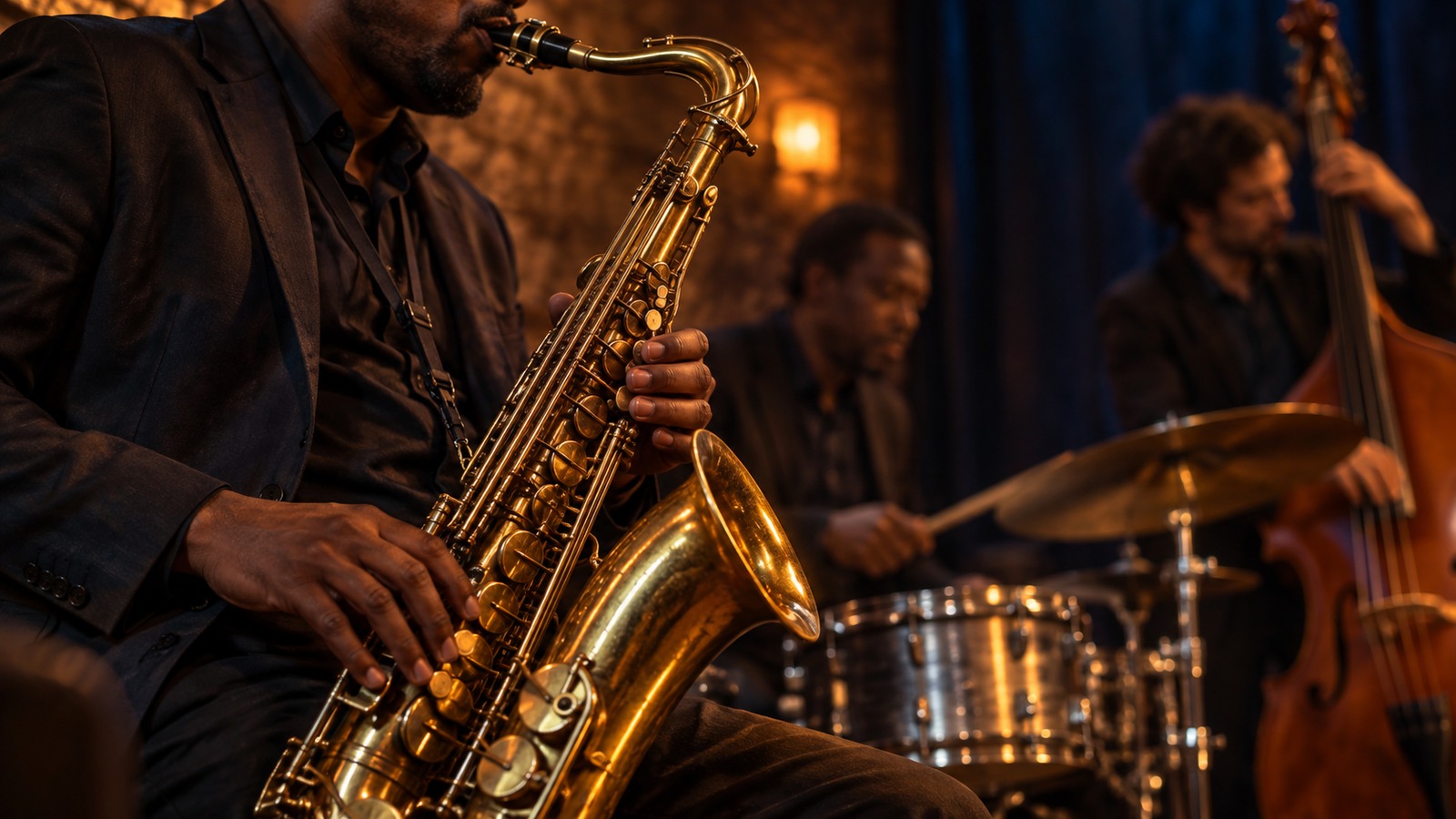
Watch a jazz ensemble closely and you may notice decisions that do not look like a fixed sequence being repeated. A drummer changes emphasis, a pianist leaves an unexpected space, and a soloist responds by taking a phrase somewhere else. The musicians can share a familiar composition while shaping a particular experience together. That active relationship is one useful way into jazz, though no single feature explains every style within its history. Improvisation is often important, swing is central to many approaches, and individual sound can matter as much as the written material. The tradition developed through African American musical life and grew through changing communities, venues, and international exchanges. This guide introduces the musical relationships and historical contexts that make the category meaningful, while avoiding the idea that jazz has one required instrument, one emotional mood, or one level of technical difficulty.
A: No. Jazz includes several rhythmic feels beyond swing.
A: No. Players draw on learned resources and shared structures.
A: It can mean one complete pass through the form.
A: Yes. Interpretation, balance and phrasing remain active choices.
A: No. Many instrumental combinations can serve the tradition.
A: No. Different approaches continue developing beside one another.
A: They connect musical practices to particular communities and histories.
A: The drummer can respond, color and redirect the performance.
A: Yes. Sound sources do not alone determine the musical relationships.
A: Follow one appealing sound or interaction through a complete recording.
Begin With the Tradition, Not a Checklist
Jazz includes many approaches that can sound markedly different from one another. An early small ensemble, a large arranged band, a spacious modern quartet, and an electrically amplified group need not share an identical surface. A definition based only on saxophone tone or background atmosphere will therefore miss much of the music. The category connects histories and practices as well as immediately recognizable sounds.
The Smithsonian’s introduction to jazz emphasizes improvisation and its emergence through African American traditions mixed with other musical resources. That frame is a useful beginning, but it should lead toward particular performances. Broad descriptions become informative when a listener hears how musicians actually use them. Otherwise, a label can remain an abstraction detached from the work it is meant to describe.
It also helps to distinguish defining a tradition from policing a boundary. Musicians may challenge familiar practices while still working in conversation with jazz history. Listeners can disagree about a classification without reducing the performance to a verdict about whether it deserves attention. The more rewarding task is to explain which relationships are present and what the players accomplish through them.
Improvisation Is Invention With Resources
Improvisation means shaping musical ideas during performance, but it does not require inventing without preparation, memory, or structure. Players draw on learned sounds, technical skill, compositional knowledge, and previous listening. A new phrase can emerge from transforming familiar material in response to the moment. The spontaneity lies in the particular choices and relationships, not in an absence of training. Some passages may be closely planned while others remain more open, and the contrast can belong to one performance. A beginning listener can hear development through repeated gestures, changing density, and a sense of direction without needing to identify every theoretical resource the player uses.
Swing Is a Feel, and Jazz Has Other Feels
Count Basie’s 1937 ‘One O’Clock Jump’ makes swing easier to hear than a definition alone. A steady underlying pulse supports offbeat accents, repeated riffs and changing solo voices; the beat stays legible while the players make it lean and spring. The Hancock Institute’s curriculum uses Basie as a swing example. Contrast that with Dave Brubeck’s 1959 ‘Take Five’: its recurring five-beat cycle gives the music another gait, yet interaction and improvisation remain central. Swing is one important feel within jazz, rather than a requirement that every recording use the same subdivision.
Not all jazz uses that feel. Straight-eighth approaches, different meters, dance-oriented grooves, and freer rhythmic relationships can all appear within the tradition. The Jazz in America introduction explicitly includes music that does not swing in the narrower rhythmic sense. Hearing that variety prevents one useful vocabulary term from becoming a rule that excludes much of the music it was intended to help explain.
Form Gives the Players Shared Orientation
A performance often uses a composition or agreed structure that musicians can follow together. Returning harmonic sequences, melodic sections, rhythmic patterns, or other signposts give participants an orientation. A soloist can explore within that framework while the ensemble maintains its relation to the larger movement. Structure is therefore a resource for invention rather than automatically its opposite.
The term chorus in jazz can mean a complete pass through the form, not necessarily the repeated refrain familiar from pop songs. Hearing several passes can reveal how a player develops ideas over a recurring sequence. You do not have to count every measure to notice the return of a recognizable destination. Repeated listening gradually makes that orientation more apparent.
Some music uses less predictable forms or explores freer coordination. Those approaches still involve decisions about attention, sound, and relationship. Freedom does not mean every player ignores the others. The relevant question changes from identifying a repeated harmonic route to hearing how the musicians organize an event whose boundaries may be established through different kinds of cues.
The Rhythm Section Shapes the Conditions
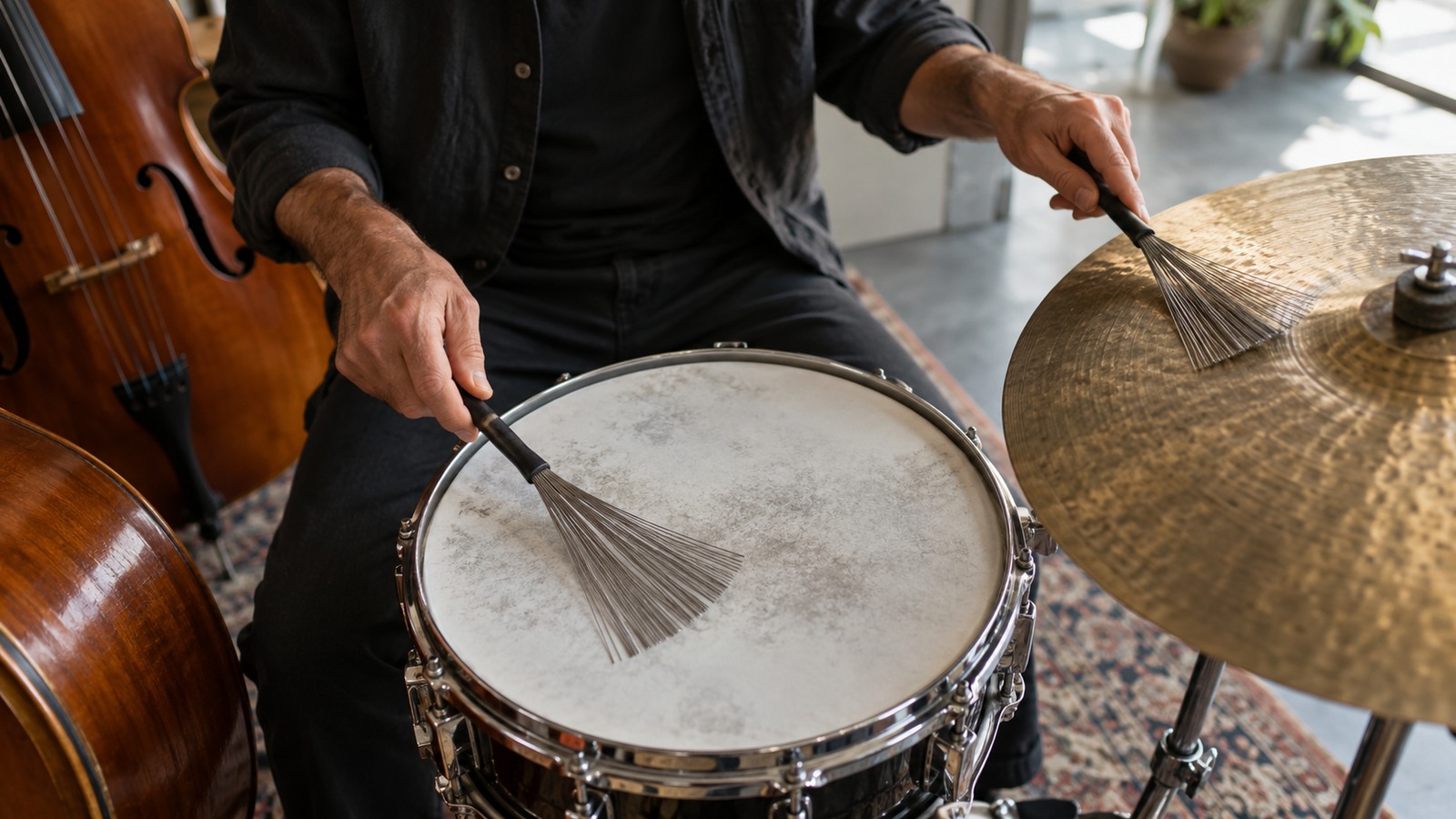
A rhythm section commonly includes some combination of bass, drums, piano, guitar, or other instruments that help organize pulse and harmony. Its work is active throughout the performance. A pianist can supply a chord, leave room, or introduce tension; a bassist can guide movement; a drummer can change the emphasis of the moment. The leading solo does not happen over a background that has stopped making choices. Listening to one supporting role at a time helps reveal this activity. What initially sounds like accompaniment can become an exchange in which several musicians influence the soloist’s direction and the listener’s sense of time.
Individual Sound Is Part of the Meaning
Jazz listeners often recognize a performer through tone and phrasing before identifying the composition. The attack of a horn, the weight of a piano chord, or the placement of a sung syllable can communicate personality. Technical ability makes these choices possible, but a uniform ideal of clean execution does not explain every expressive achievement. A musician’s distinct sound can be a central resource.
This is why copying written pitches does not necessarily reproduce a performance. Duration, articulation, emphasis, and the surrounding ensemble determine how the material behaves. The score may identify an idea, while the player’s decisions give it a particular presence. Hearing those differences does not require dismissing composition. It recognizes interpretation as another part of how music becomes meaningful.
Composition and Arrangement Remain Essential
The prominence of improvisation sometimes produces the mistaken impression that jazz musicians simply begin playing and hope the result becomes coherent. In practice, written material, rehearsal, agreed roles, and arrangement can be highly important. A large ensemble especially needs ways to coordinate entrances, textures, and foreground changes. The performance may then open selected spaces for individual invention.
Arrangement determines what the listener can distinguish. A melody can be passed between instrumental groups, a supporting figure can prepare a solo, or a change in texture can give a familiar section new significance. The players interpret those decisions rather than turning into a neutral delivery mechanism. Even a closely written passage depends on phrasing, balance, and the particular character of its performance.
The balance between planned and improvised activity varies across artists and projects. Neither maximum freedom nor maximum notation guarantees quality. Both offer resources that can be used persuasively or without clear direction. The useful assessment asks how the choices support the musical experience rather than treating one method as inherently more authentic.
Origins Belong to Communities and Circumstances
New Orleans provides a concrete starting point for the early history. Brass-band practices, dance music, blues, ragtime and community performance intersected there within a racially unequal society. Louis Armstrong’s 1928 ‘West End Blues,’ recorded after his move into a wider national recording life, makes an individual solo voice strikingly visible within an ensemble tradition. His opening trumpet cadenza suspends the regular beat before the group settles in. The event is audible: one player seems to command musical time, then returns to shared time with the band. That is a useful historical development to hear, not a claim that one musician invented jazz alone.
Its early settings included occasions for movement, gathering, and professional performance. That context challenges the idea that jazz has always belonged only to quiet contemplation or academic analysis. Musicians were working with audiences and practical conditions as well as artistic ambitions. Later histories changed the settings, but did not erase the social relationships through which the music developed.
A Dated Route From Swing to New Experiments
Big-band swing flourished in the 1930s: Basie’s ‘One O’Clock Jump’ and Duke Ellington’s 1940 ‘Ko-Ko’ show how arranged sections, riffs and individual soloists could share a larger ensemble. In the 1940s, bebop musicians including Charlie Parker and Dizzy Gillespie developed intricate melodic lines and mobile accents in smaller groups; Parker’s 1945 ‘Ko-Ko’ makes a useful contrast with Ellington’s differently composed piece of the same title. Miles Davis’ 1959 ‘So What’ then offers more slowly changing harmonic areas, giving soloists room to develop their own melodic paths. Ornette Coleman’s 1959 The Shape of Jazz to Come reconsiders the need for a chord-playing instrument, while Hancock’s 1973 Head Hunters brings electric keyboards and funk-centered repetition into another ensemble language. The Hancock Institute’s historical outline places these developments within overlapping periods. Listen for the changed relationship among accompaniment, pulse and soloist; the difference is more useful than memorizing a row of labels.
Global Jazz Adds Local Musical Thinking
A specific international route is South African pianist Abdullah Ibrahim’s 1974 ‘Mannenberg,’ recorded with Cape Town musicians including saxophonist Basil Coetzee. Its repeating piano figure and relaxed, unfolding saxophone lines offer a different point of entry from a rapid bebop solo. The recording draws attention to local musical relationships rather than treating a musician outside the United States as an imitation of an American original. Global jazz consists of such particular work: performers carry shared resources into distinct languages, political circumstances, dance practices and ensemble sounds.
Global development does not make its African American origins irrelevant. Acknowledging roots and hearing later invention are compatible tasks. Specific credit provides a stronger foundation for exchange than an account that turns influence into anonymous musical material. The listener can value a new approach while remaining attentive to the traditions and communities with which it is in dialogue.
The same principle applies when jazz interacts with other genres. An electronic texture or a dance rhythm does not by itself explain whether the musical relationship is persuasive. Listen to how performers organize expression, improvisation, and ensemble roles in the resulting work. The surface may be unfamiliar while the underlying habits of musical conversation remain audible.
The Listener Has More Than One Way In
A first encounter need not begin with the most historically celebrated or theoretically complex recording. Choose a sound that gives you a reason to stay: a melodic line, a singer’s phrasing, a lively groove, or an interesting exchange between instruments. Give it a complete hearing before deciding that one challenging passage represents the whole genre. Familiarity can make the relationships easier to follow.
A second playback can focus on something different. Hear the bass during a solo, follow the drummer’s responses, or notice when a melody returns after development. These are practical attention choices rather than a test of musical literacy. They help convert a seemingly dense surface into several intelligible relationships, each of which can lead toward another recording or artist.
Keep the Definition Open to the Music
Jazz is an evolving tradition whose histories and practices connect individual expression with active musical relationships. Improvisation, rhythmic character, shared forms, distinctive sound, and ensemble responsiveness offer useful ways to hear it. They are not a rigid checklist applied identically to every project. A persuasive definition should make the music more available rather than smaller. Listen with the historical frame in mind, then return to what a particular performance actually does. Hear the planned and the open, the individual and the collective, and the relationship between a familiar structure and a new decision. Those contrasts give the tradition much of its continuing range. Understanding jazz begins with attention that allows musicians’ differences to become audible, without requiring every encounter to confirm one predetermined sound.